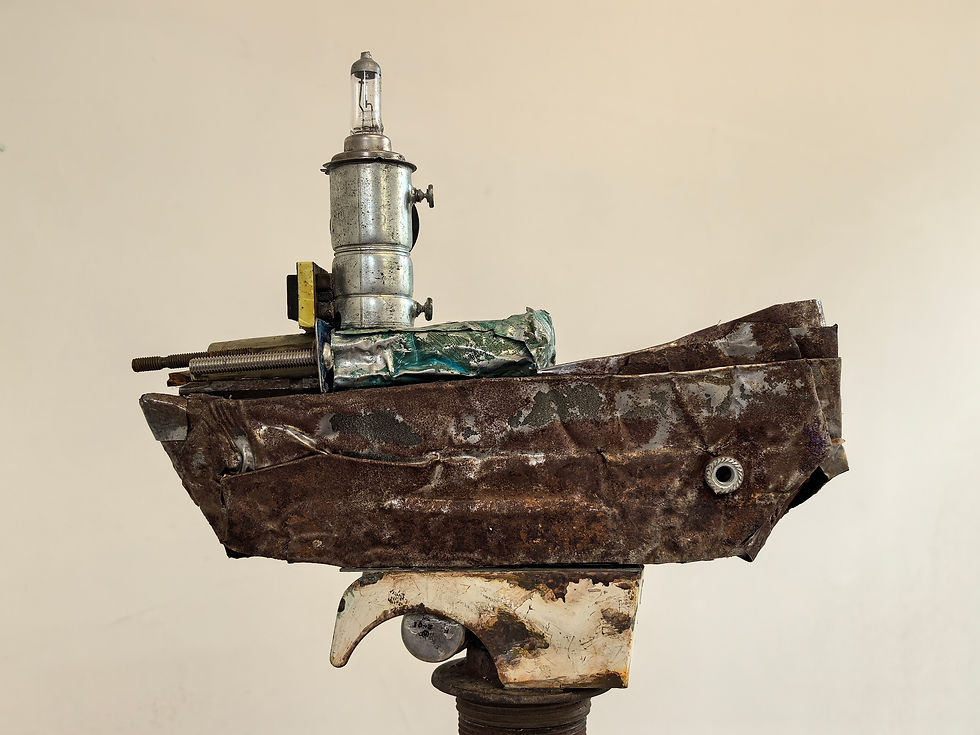
Rusty Ark
With this sculpture, I tried a different approach to making. Instead of beginning with a blueprint or a detailed plan, I started with discarded car parts, metals, and fragments collected from a local junkyard. Using simple tools—glue, scissors, and a hammer—I assembled the pieces by intuition, responding to their shapes, textures, and histories. The process felt more like discovery than design—finding a form hidden inside the materials.


The final result resembles both a whale and a boat --- an ambiguous shape between life and machine. It’s part of my ongoing series of works that imagine objects from future worlds shaped by ecological collapse. This piece, in particular, serves as a memorial for fish—creatures that may one day exist only through fossil traces or mechanical reconstructions. I want the piece to feel like a bridge between past and future, where the echoes of living creatures persist in unexpected forms. The sculpture invites viewers to consider the fragility of ecosystems and the traces we leave behind, both natural and manufactured.
Production


I think of it as an artifact from a future archaeology, built by someone trying to remember the ocean through the debris of the industrial age. The corroded surfaces and roughly welded joints speak to the limits of preservation and reconstruction. Each mark and imperfection carries a story, hinting at the human hands and mechanical processes that brought it into being. Like an archaeologist piecing together meaning from fragments, this sculpture suggests that memory itself can be rebuilt—but never perfectly.
Process